Cut & Dried: A Woodworker's Guide to Timber Technology
by Richard Jones
Serious woodworkers have long been starved of accurate information on wood technology that’s explained in language for artisans – instead of for scientists.
Author Richard Jones has spent his entire life as a professional woodworker and has dedicated himself to researching the technical details of wood in great depth, this material being the woodworker’s most important resource. The result is “Cut & Dried: A Woodworker’s Guide to Timber Technology.” In this book, Richard explores every aspect of the tree and its wood, from how it grows to how it is then cut, dried and delivered to your workshop.
Richard explores many of the things that can go right or wrong in the delicate process of felling trees, converting them into boards, and drying those boards ready to make fine furniture and other wooden structures. He helps you identify problems you might be having with your lumber and – when possible – the ways to fix the problem or avoid it in the future.
“Cut & Dried” is a massive text that covers the big picture (is forestry good?) and the tiniest details (what is that fungus attacking my stock?). And Richard offers precise descriptions throughout that demanding woodworkers need to know in order to do demanding work.
Some examples:
- Where trees grow and how they are harvested makes an enormous difference to the quality of your stock. “Cut & Dried” explains many of the methods used in the U.S. and Europe to cut down trees and convert them into usable boards.
- How that stock is dried determines whether it will end up in your furniture or in a fireplace. Drying defects can crop up at any stage and can ruin a board (or an entire tree). Learn to identify the problems, to test your theories and avoid bad timber.
- We all know that wood moves. But a deep understanding of the process eludes many woodworkers – even professionals. It is a complex process, but can be easily understood by the furniture maker who makes the effort. Learn how your boards distort, why they distort and what exactly happens when boards take on or release water vapor.
- Even if you have found the perfect board, it can be attacked by spores, fungi or pests. Learn to identify and prevent them from ruining your entire stock of lumber.
- Wood has its limits. If you want to use the right piece of wood in an assembly, you need to understand how much stress it can take and from what direction. “Cut & Dried” explains it better than any source we’ve discovered.
The primary reason we decided to publish “Cut & Dried” is that Richard’s book provides a complete picture of how wood works. If you are decidedly non-technical and hate math, you’ll find what you need here. Richard explains how trees work in terms any woodworker can understand.
But for those woodworkers who want to understand “why” comprehensively, Richard has delved thoroughly into the science and math behind wood technology. You can go as deep as you like.
Representing years of research and a lifetime of working with wood, “Cut & Dried” is intended to become the definitive book on the subject for practicing craftspeople.
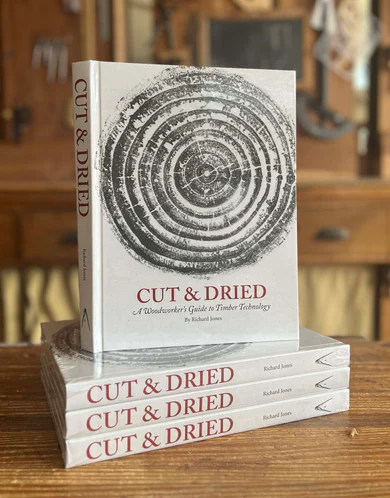
“Cut & Dried: A Woodworker’s Guide to Timber Technology” also requires a significant investment by Lost Art Press to produce and print. Here’s why: At 336 pages, “Cut & Dried” measures 9” x 12” and the text is printed on heavy #80 matte-coated paper for accurate color. This is a book that is designed to outlast us all and retain its brilliant colors. The pages are sewn and casebound for durability. Our books survive babies, dogs and floods.
Contents
Foreword ix
Acknowledgments xi
1: Introduction 3
2: Tree Distribution 19
3: Tree Classification, Growth & Structure 23
4: Roots, Leaves, Seeds, Flowers, Germination, Transpiration, Woodland Regeneration 29
5: Felling, Conversion & Yield 47
6: Water, Water Vapour & Wood 69
7: Coping with Wood Movement 93
8: Seasoning or Drying of Wood 119
9: Drying Faults 147
10: From the Kiln to the User 155
11: Fungi & Wood 169
12: Insect Pests 187
13: Characteristics of Timber 203
14: Wood Strength & Structures 219
15: Ecological & Environmental Issues 253
About the Author 271
Glossary 273
Bibliography 287
Websites 306
Appendix 309
Hardcover
Description
by Richard Jones
Serious woodworkers have long been starved of accurate information on wood technology that’s explained in language for artisans – instead of for scientists.
Author Richard Jones has spent his entire life as a professional woodworker and has dedicated himself to researching the technical details of wood in great depth, this material being the woodworker’s most important resource. The result is “Cut & Dried: A Woodworker’s Guide to Timber Technology.” In this book, Richard explores every aspect of the tree and its wood, from how it grows to how it is then cut, dried and delivered to your workshop.
Richard explores many of the things that can go right or wrong in the delicate process of felling trees, converting them into boards, and drying those boards ready to make fine furniture and other wooden structures. He helps you identify problems you might be having with your lumber and – when possible – the ways to fix the problem or avoid it in the future.
“Cut & Dried” is a massive text that covers the big picture (is forestry good?) and the tiniest details (what is that fungus attacking my stock?). And Richard offers precise descriptions throughout that demanding woodworkers need to know in order to do demanding work.
Some examples:
- Where trees grow and how they are harvested makes an enormous difference to the quality of your stock. “Cut & Dried” explains many of the methods used in the U.S. and Europe to cut down trees and convert them into usable boards.
- How that stock is dried determines whether it will end up in your furniture or in a fireplace. Drying defects can crop up at any stage and can ruin a board (or an entire tree). Learn to identify the problems, to test your theories and avoid bad timber.
- We all know that wood moves. But a deep understanding of the process eludes many woodworkers – even professionals. It is a complex process, but can be easily understood by the furniture maker who makes the effort. Learn how your boards distort, why they distort and what exactly happens when boards take on or release water vapor.
- Even if you have found the perfect board, it can be attacked by spores, fungi or pests. Learn to identify and prevent them from ruining your entire stock of lumber.
- Wood has its limits. If you want to use the right piece of wood in an assembly, you need to understand how much stress it can take and from what direction. “Cut & Dried” explains it better than any source we’ve discovered.
The primary reason we decided to publish “Cut & Dried” is that Richard’s book provides a complete picture of how wood works. If you are decidedly non-technical and hate math, you’ll find what you need here. Richard explains how trees work in terms any woodworker can understand.
But for those woodworkers who want to understand “why” comprehensively, Richard has delved thoroughly into the science and math behind wood technology. You can go as deep as you like.
Representing years of research and a lifetime of working with wood, “Cut & Dried” is intended to become the definitive book on the subject for practicing craftspeople.
“Cut & Dried: A Woodworker’s Guide to Timber Technology” also requires a significant investment by Lost Art Press to produce and print. Here’s why: At 336 pages, “Cut & Dried” measures 9” x 12” and the text is printed on heavy #80 matte-coated paper for accurate color. This is a book that is designed to outlast us all and retain its brilliant colors. The pages are sewn and casebound for durability. Our books survive babies, dogs and floods.
Contents
Foreword ix
Acknowledgments xi
1: Introduction 3
2: Tree Distribution 19
3: Tree Classification, Growth & Structure 23
4: Roots, Leaves, Seeds, Flowers, Germination, Transpiration, Woodland Regeneration 29
5: Felling, Conversion & Yield 47
6: Water, Water Vapour & Wood 69
7: Coping with Wood Movement 93
8: Seasoning or Drying of Wood 119
9: Drying Faults 147
10: From the Kiln to the User 155
11: Fungi & Wood 169
12: Insect Pests 187
13: Characteristics of Timber 203
14: Wood Strength & Structures 219
15: Ecological & Environmental Issues 253
About the Author 271
Glossary 273
Bibliography 287
Websites 306
Appendix 309
Hardcover